
Cart is empty
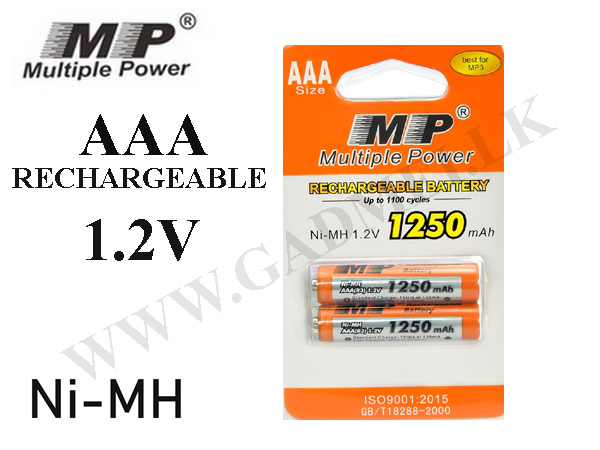

RECHARGEABLE BATTERY AAA MP 1250mAH (2PACK)
Special Price LKR 1750.00
Regular Price:
- Islandwide Delivery Available
This battery detail typically refers to a 1.2V MP brand NiMH (Nickel-Metal Hydride) AA rechargeable battery rated at 1250 mAh capacity.
For: TV remotes, laser pointers, digital thermometers, wireless keyboards, headlamps,etc.,
-
Energy Storage: 1250 mAh indicates the battery can deliver 1250 mA of current for 1 hour, or 125 mA for approximately 10 hours under standard discharge conditions.
-
Common Applications: Used in moderate-drain electronic devices such as computer mice, keyboards, digital clocks, wireless remotes, low-power flashlights, and toys.
-
Charging Standard: Requires a compatible NiMH smart charger. The standard slow-charging rate is typically around 125 mA for 14–16 hours, while smart chargers auto-cut at full voltage (~1.4V peak).
MP AAA Rechargeable Batteries (1.2V NiMH)
AAA cells are smaller and lighter, carrying lower capacities (typically 800 mAh – 1100 mAh), designed for slim, compact, or low-to-medium drain electronics.
Common Usage Items:
-
Remotes & Control Interfaces: TV / Set-top box / AC remote controls, smart TV air mice, presentation laser clickers.
-
Computer Peripherals: Standard wireless computer mice, wireless compact keyboards.
-
Personal Care & Medical: Electric trimmers, digital thermometers, blood pressure monitors, pulse oximeters, facial cleansing brushes.
-
Compact Lighting: Mini pocket flashlights, headlamps, penlights.
-
Household & Security Gadgets: Digital wall/desk clocks, wireless doorbells, smart sensor units, digital weighing scales.
| Specification | Details |
| Brand / Series | MP (Mega Power / Max Power) |
| Chemistry | NiMH (Nickel-Metal Hydride) |
| Nominal Voltage | 1.2V DC |
| Capacity | 1250 mAh (milliampere-hours) |
| Standard Size | AA (Standard Cylindrical Cell) |
| Recharge Cycle Life | ~500 to 1,000 charge cycles |
ABOUT Ni-MH
NiMH stands for Nickel-Metal Hydride. It is a widely used rechargeable battery chemistry designed to serve as a direct, reusable replacement for standard 1.5V alkaline single-use batteries.
Core Construction & Chemistry
A standard NiMH cell operates at a nominal voltage of 1.2V and consists of three main active components:
-
Positive Electrode (Cathode): Made of Nickel Hydroxide Ni(OH)2
-
Negative Electrode (Anode): Made of a Hydrogen-Absorbing Metal Alloy (a specialized mixture of metals like lanthanum, cerium, nickel, and manganese).
-
Electrolyte: An alkaline solution of Potassium Hydroxide KOH
During charging, hydrogen ions are driven from the positive electrode into the metal alloy of the negative electrode, where they are stored as metal hydrides. When discharging to power a device, hydrogen flows back, releasing electrons to generate electrical current.
Key Advantages of NiMH Chemistry
-
Higher Energy Capacity: Delivers 2 to 3 times the capacity of older NiCd (Nickel-Cadmium) batteries of equivalent size.
-
Cadmium-Free (Environmentally Safer): Replaced toxic cadmium with non-toxic hydrogen-absorbing alloys, making them easier to recycle and less hazardous to the environment.
-
Minimal Memory Effect: Unlike NiCd batteries, NiMH cells do not suffer from severe memory loss. You do not need to discharge them completely before recharging.
-
High-Drain Output: Low internal resistance allows them to deliver steady high current continuously, making them ideal for power-hungry gear like camera flashes, wireless microphones, and motorized toys.
Limitations to Keep in Mind
-
Self-Discharge Rate: Standard NiMH batteries lose 1% to 2% of their stored charge per day when sitting idle on a shelf (though low self-discharge "LSD" variants reduce this significantly).
-
Heat Sensitivity: NiMH cells generate internal heat during fast charging. Overcharging them damages cell capacity, which is why smart chargers with temperature and voltage monitoring (-\Delta V) are recommended.
-
1.2V vs 1.5V Nominal: While alkaline batteries start at 1.5V and rapidly decline down to 0.9V, NiMH holds a flat output near 1.2V for almost 80% of its discharge curve before dropping off.